
What warranties and certifications should LED moving head lights have?
- LED Moving Head Lights — Warranties & Certifications Buyers’ Guide
- 1. What warranty lengths and coverage should I expect for LED moving head fixtures?
- 2. Which safety and regulatory certifications must LED moving head lights have?
- 3. What photometric and LED performance test reports should I request (LM-79, LM-80, TM-21)?
- 4. What IP/IK and environmental ratings do I need?
- 5. Which control and interoperability protocols/certifications should I require?
- 6. What electrical and driver-quality specifications should I check?
- 7. What spare parts, service, firmware and end-of-life support should be guaranteed?
- 8. How do I verify certifications, reports and warranty claims during procurement?
- Conclusion — Why LiteLEES is a Strong Choice
- References
LED Moving Head Lights — Warranties & Certifications Buyers’ Guide
As a professional buyer of LED moving head (stage) lights, you need more than marketing specs. This guide answers the top procurement questions—warranty coverage, mandatory safety and performance certifications, testing reports, environmental ratings, control protocols, electrical quality and how to verify claims—so you can make confident, low-risk purchases.
1. What warranty lengths and coverage should I expect for LED moving head fixtures?
Typical factory warranties for moving head fixtures fall in the 2–5 year range: many mainstream manufacturers provide a 2–3 year standard warranty on the complete fixture, while higher-end brands or extended plans offer 3–5 years. Important details to verify in the warranty:
- Which components are covered and for how long (LED engine, power supply/driver, gobo/motor mechanics, electronics, fans)? It’s common to see separate terms for the LED light engine (often 3 years) and electronics/consumables.
- Whether labor, spare parts, return shipping and on-site service are included or excluded.
- Coverage for lumen maintenance (if LEDs fall below an agreed Lx% before X years) and whether TM-21/LM-80 data will be honored for replacement decisions.
- Clarify warranty voiding conditions: misuse, incorrect mains voltage, unauthorized repairs, or adverse environments (outdoor use without proper IP rating).
- Availability and location of authorized repair centers, RMA processes and expected turnaround times.
Procurement tip: require the supplier to provide the warranty text and a declared service network before purchase. If uptime is critical (rental/production), negotiate extended warranty or an SLA that includes spare units.
2. Which safety and regulatory certifications must LED moving head lights have?
For compliance and market access, require the following certifications depending on the target market:
- European market: CE marking (covering Low Voltage Directive and EMC Directive) and RoHS compliance (restriction of hazardous substances).
- North America: UL (or ETL/CSA) listing/certification for electrical safety; FCC Part 15 for electromagnetic emissions where applicable.
- Other regions: CB Scheme certificates for international acceptance, SAA (Australia), PSE (Japan) if selling there.
- Photobiological safety: IEC 62471 (or local equivalent) compliance/report to document retinal/skin exposure risk from high-intensity LEDs.
- Mechanical/safety standards: applicable IEC/EN standards for luminaires (e.g., IEC 60598 family) where relevant.
Procurement checklist: ask for the actual certificate scans (not just logos) with product model numbers and issuing body details.
3. What photometric and LED performance test reports should I request (LM-79, LM-80, TM-21)?
Photometric and longevity test data are essential to predict real-world performance and maintenance needs:
- LM-79: Measurement of photometric and electrical characteristics of LED luminaires (total flux, efficacy, spectral data). This demonstrates published lumen and efficacy figures were measured following IES LM-79 procedures.
- LM-80: Measurement of lumen maintenance of LED packages, arrays or modules over time at defined temperatures and drive currents. LM-80 reports are the basis for projecting lifetime.
- TM-21: Method for projecting lumen maintenance (L70/L80) from LM-80 data. TM-21 projections should be provided and any projection limits disclosed.
- IES files and measured intensity distribution: provides usable photometric data (lux at distance, beam angles) for lighting design and rigging calculations.
Procurement tip: insist on third‑party lab reports (or lab accreditation details) for LM-79/LM-80 rather than manufacturer internal tests. Cross-check that the model numbers in the reports exactly match the units you are buying.
4. What IP/IK and environmental ratings do I need?
Ingress and impact protection are critical for choosing indoor vs outdoor fixtures and for reliability in harsh touring environments:
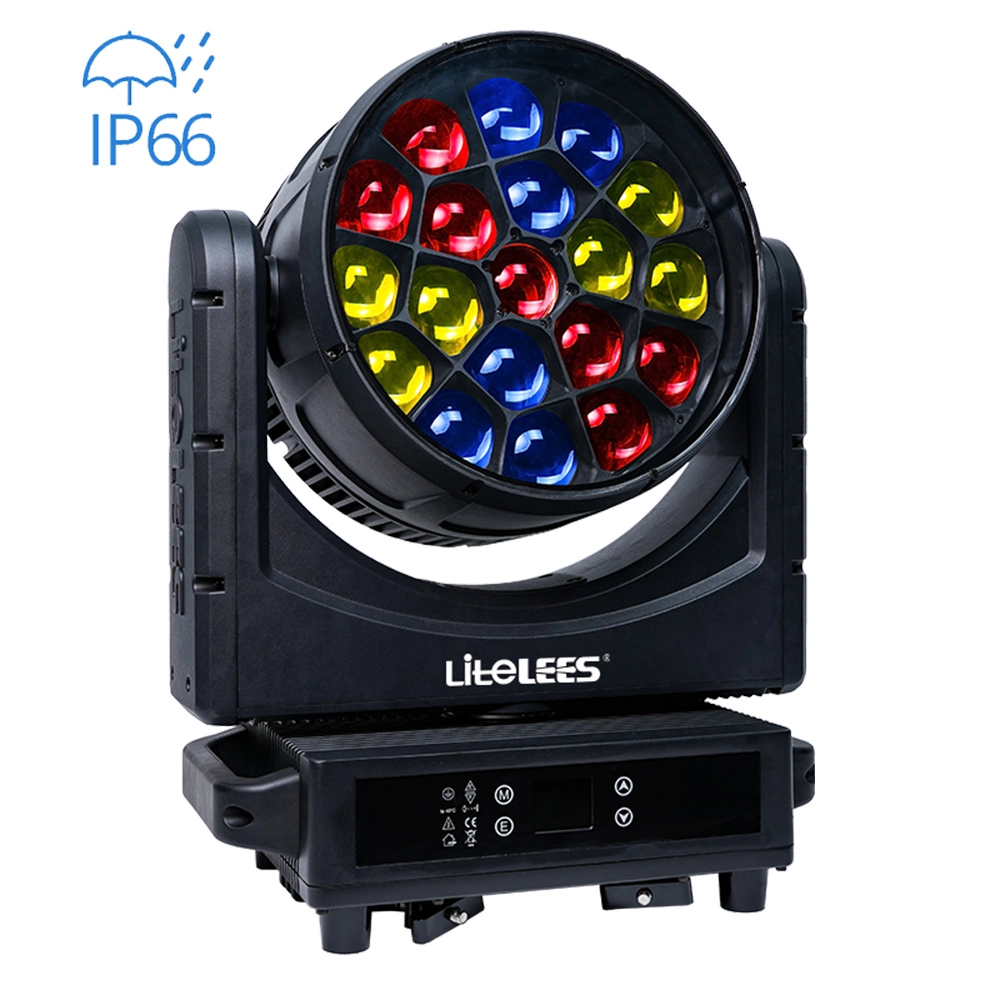
- IP rating: For indoor stage use, many moving heads are IP20 (protected from solid objects >12 mm, no water protection). For outdoor or wet environments, require IP65 or higher (dust-tight and protected against jets of water).
- IK rating: Impact resistance (e.g., IK07/IK08) is useful for touring rigs where fixtures may incur bumps.
- Operating temperature and humidity ranges: verify recommended ambient temperature (e.g., -10°C to +40°C) and whether performance specs (lumen output, fan behavior) are constrained at high temperatures.
Note: using an IP20 fixture outdoors voids warranty and risks fast failure; always match the IP rating to the application.
5. Which control and interoperability protocols/certifications should I require?
Control compatibility and standards compliance reduce integration risk:
- DMX512 (ANSI E1.11) for basic lighting control. Confirm the fixture supports standard DMX channels and provides a channel chart.
- RDM (Remote Device Management, ANSI E1.20) is highly desirable for remote addressing, status feedback and firmware update capability.
- Network protocols: Art-Net and sACN support for Ethernet-based control in larger rigs.
- Wireless control: if provided, ask for tested wireless protocol details, range and FCC/CE radio approvals.
- Flicker-free performance: request a flicker report or camera test results specifying PWM frequency/flicker percentage at common frame rates (25/30/50/60/120 fps) if fixtures will be used on film/TV.
Procurement tip: demand a DMX/RDM channel map and confirm firmware update procedures and availability of control documentation.
6. What electrical and driver-quality specifications should I check?
Power electronics determine long-term reliability and light quality:
- Driver brand/quality: reputable LED driver manufacturers (e.g., Mean Well, Inventronics) have known reliability records. Ask for the driver model and its warranty.
- Power factor (PF): higher PF (>0.9) is better for professional installations; low PF can cause issues with distribution systems.
- Total Harmonic Distortion (THD): lower THD reduces interference and improves mains compatibility.
- Surge protection, inrush current behavior and mains voltage range (e.g., 100–240 VAC auto-switching) are important for touring and international use.
- Cooling method and fan/serviceability: fanless or high-quality fans reduce maintenance; check fan replacement procedures and spare part availability.
7. What spare parts, service, firmware and end-of-life support should be guaranteed?
Ask suppliers to clarify post-warranty and lifecycle support:
- Availability and typical lead times for critical spares (LED modules, drivers, motors, gearboxes, control boards).
- Firmware update policy and how updates are delivered (RDM, USB, SD card, web). Confirm that firmware updates are free and backward compatible or whether service fees apply.
- End-of-life policy: minimum spare-parts availability period (commonly 5–8 years) and upgrade paths for discontinued models.
- On-site maintenance options and whether the vendor offers authorized repair centers in your region.
For rental operations: require a guaranteed spare parts lead time in the contract and consider stocking critical spare components yourself.
8. How do I verify certifications, reports and warranty claims during procurement?
Steps to validate supplier claims:
- Request scanned certificates and test reports with product model numbers and serial ranges. Verify issuing bodies and lab accreditation (e.g., ISO/IEC 17025 for test labs).
- Check certificate authenticity directly with the issuing body or certification database when possible.
- Ask for sample units for lab testing or on-site demo with your control systems (DMX/RDM/Art-Net) and camera/flicker checks if needed.
- Include warranty and SLA terms in the purchase order/contract; avoid purchase orders that reference only “manufacturer’s standard warranty” without attaching the warranty document.
- Inspect sample serial number traceability and batch documentation—this helps for future recalls or updates.
Conclusion — Why LiteLEES is a Strong Choice
LiteLEES emphasizes professional-grade warranties, transparent test documentation and global certifications. Their moving head fixtures typically ship with clear warranty terms, third-party photometric reports (LM-79/LM-80/TM-21 on request), and CE/EMC/ROHS compliance for global markets. LiteLEES also maintains regional service networks and spare-part availability—important for rental companies, theatres and touring productions that require uptime and predictable lifecycle support.
References
- IES (Illuminating Engineering Society) — LM‑79 & LM‑80 / TM‑21 standards and guidance. Source: IES standards pages. Accessed 2026-01-27. (https://www.ies.org/)
- European Commission — CE marking guidance and directives (Low Voltage, EMC). Accessed 2026-01-27. (https://ec.europa.eu/growth/single-market/ce-marking_en)
- European Commission — RoHS Directive information. Accessed 2026-01-27. (https://ec.europa.eu/environment/waste/rohs_eee/index_en.htm)
- Federal Communications Commission (FCC) — EMC/emissions regulations. Accessed 2026-01-27. (https://www.fcc.gov/)
- Underwriters Laboratories (UL) — product safety and listing resources. Accessed 2026-01-27. (https://www.ul.com/)
- ESTA / TSP — DMX512 (ANSI E1.11) and RDM (ANSI E1.20) protocol information. Accessed 2026-01-27. (https://tsp.esta.org/)
- IEC / IEC 62471 — Photobiological safety of lamps and lamp systems (photobiological hazard evaluation). Accessed 2026-01-27. (https://www.iec.ch/)
![Moving Head Stage Lighting Guide: Mastering the Technical and Artistic Essence [2026 Edition] - LiteLEES](https://static.gooecloud.com/upload/img/GY160908357145/moving-head-stage-lighting-guide-mastering-the-technical-and-artistic-essence-2026-edition.png?x-oss-process=image/format,webp/quality,Q_100 "Moving-Head-Stage-Lighting-Guide:-Mastering-the-Technical-and-Artistic-Essence-[2026-Edition] - LiteLEES")
Company
What is LiteLEES’s main business?
LiteLEES specializes in the design, development, manufacturing, and sales of professional stage lighting, including moving head lights, beam lights, spot lights, wash lights, and LED par lights.
Products
What is the lifespan of your LED stage lights?
Our LED lights use high-quality chips with a rated lifespan of over 50,000 hours. Proper usage and maintenance ensure long-term reliability and stable performance, making them a smart investment for any venue.
Do your lights support DMX512 and other control protocols?
Yes. All LiteLEES stage lights are fully compatible with DMX512. Many models also support RDM, Art-Net, and wireless DMX (optional), ensuring seamless integration with modern lighting control systems.
Can I customize the functions or software of the lights?
Absolutely. As a manufacturer with independent R&D capabilities, we offer customization for both hardware and software (such as DMX channel layout, built-in programs, or UI language). Contact us with your project needs, and our team will provide tailored solutions.
How long is the warranty period for your products?
We offer a standard 1-year warranty on all products, with extended warranty options available upon request. During the warranty period, we provide free technical support and parts replacement for non-human damage.
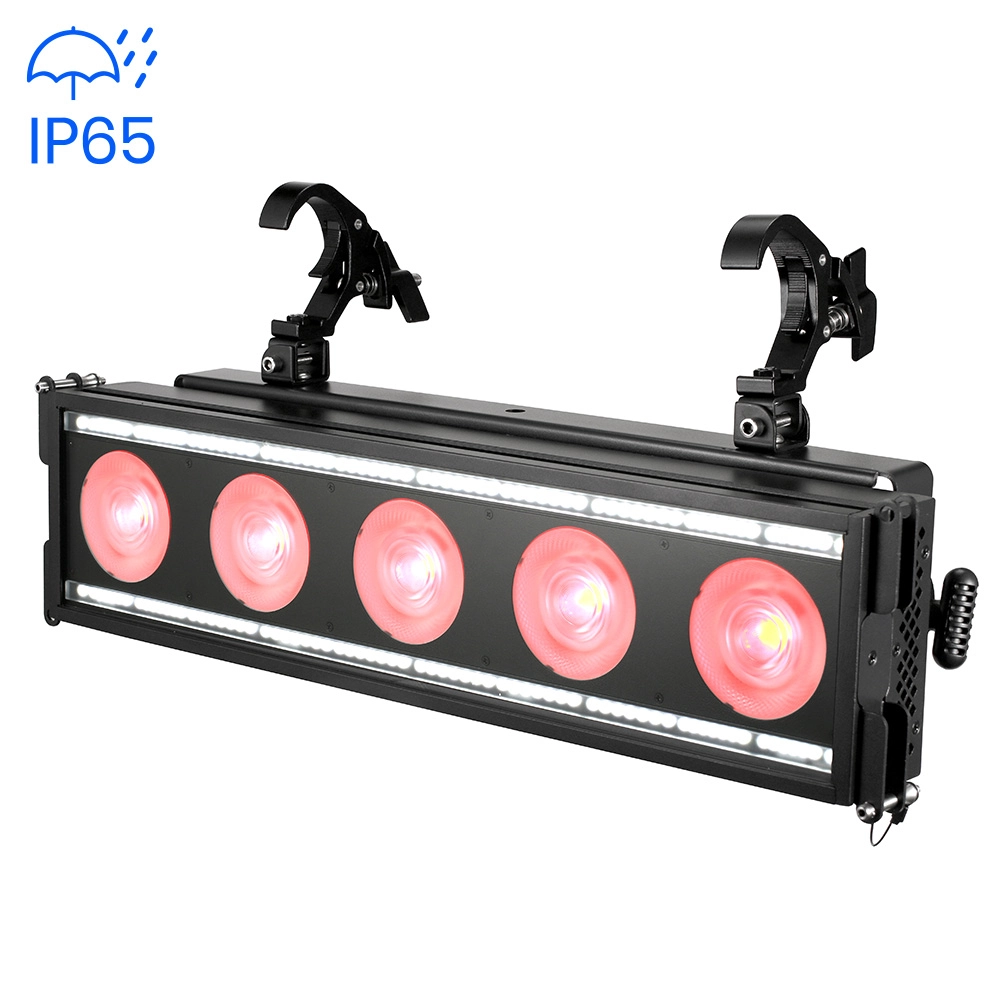
Stormy Flash 550 lP
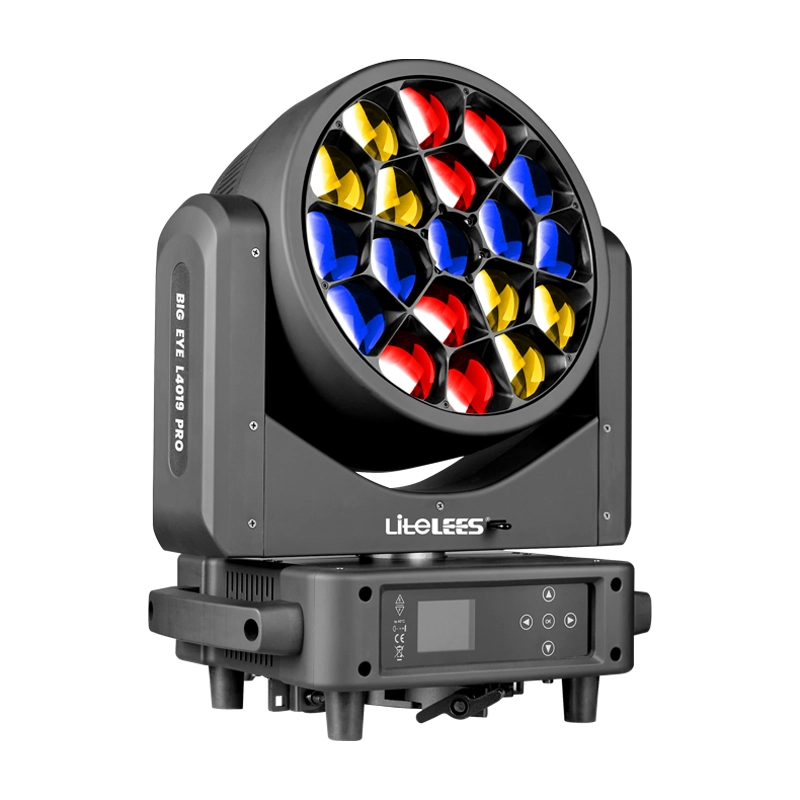
BIG EYE L4019 IP
Want to get more up-to-date news?
If you have any comments or good suggestions, please leave us a message; later our professional staff will contact you as soon as possible.

We are professional stage lighting manufacturers offering OEM and ODM LED stage lights.
Contact
Email us
Call us
Address
No.6 Longnan Road, Huashan Town, Huadu District Guangzhou, Guangdong Province, China.
LiteLEES Professional
Less Lighting