
High CRI vs. TLCI vs. TM-30: The Professional's Guide to Selecting White LED Stage Fixtures (2026 Update)
- Executive Summary: The State of Color Fidelity in 2026
- Quick Comparison: The Three Pillars of Color Quality
- How do CRI, TLCI, and TM-30 differ for stage lighting?
- The Metric Breakdown
- The Legacy Standard: Why High CRI (Ra) Is Not Enough
- The R9 Problem
- TLCI (Qa): Designing for the Lens and Live Stream
- Why the Camera Sees Differently
- The New Professional Standard: IES TM-30 Explained
- The Two Axes of TM-30
- The Vector Graphic
- Strategic Selection: Matching Fixtures to Production Needs
- Scenario A: Pure Theatre (The "Human Eye" Standard)
- Scenario B: Broadcast & Studio (The "Sensor" Standard)
- Scenario C: Rock & Roll / Concerts (The "Impact" Standard)
- The "Hybrid" Compromise
- Expert Tips: Common Mistakes in Specifying White LEDs
- Conclusion
- FAQ
- What is considered a good CRI for professional stage lighting?
- Does high CRI always mean lower brightness (lumens)?
- Why is TLCI important for live theatre if there are no cameras?
- What is the difference between TM-30 Rf and Rg?
- Why do high CRI LEDs sometimes look green on camera?
- Can I mix fixtures with different CRI ratings on the same stage?
- What is the R9 value and why does it matter?
- Is TM-30 better than CRI for LED lights?
Executive Summary: The State of Color Fidelity in 2026
High CRI white LED stage lights are no longer the sole benchmark for professional quality; today's lighting designers must navigate a complex ecosystem of spectral metrics to ensure visual accuracy. In 2026, the transition from Tungsten to LED is largely complete, yet many professionals still rely on outdated measurements that fail to capture the nuances of modern solid-state lighting.
This guide pivots from the legacy "brightness wars" to the current era of "spectral precision." While high lumen output remains important, the industry has shifted toward holistic color rendering capabilities that satisfy both the human eye (Theatrical) and the camera sensor (Broadcast). We will demystify the three critical acronyms governing your fixture selection: CRI, TLCI, and TM-30.
Quick Comparison: The Three Pillars of Color Quality
- CRI (Color Rendering Index): The legacy standard. Good for general approximation but misses saturated colors (Red/Skin Tones).
- TLCI (Television Lighting Consistency Index): The broadcast standard. Critical for cameras, ensuring signals don't require heavy post-production grading.
- TM-30 (Technical Memorandum 30): The holistic standard. Provides a dual-metric analysis of Fidelity (Rf) and Saturation (Rg) to prevent dull or oversaturated visuals.
Key Takeaway: Relying solely on CRI Ra is a professional liability. A fixture with a CRI of 95 can still render skin tones poorly if its R9 value is low, or appear green on camera if its spectral spike misaligns with the sensor.
How do CRI, TLCI, and TM-30 differ for stage lighting?
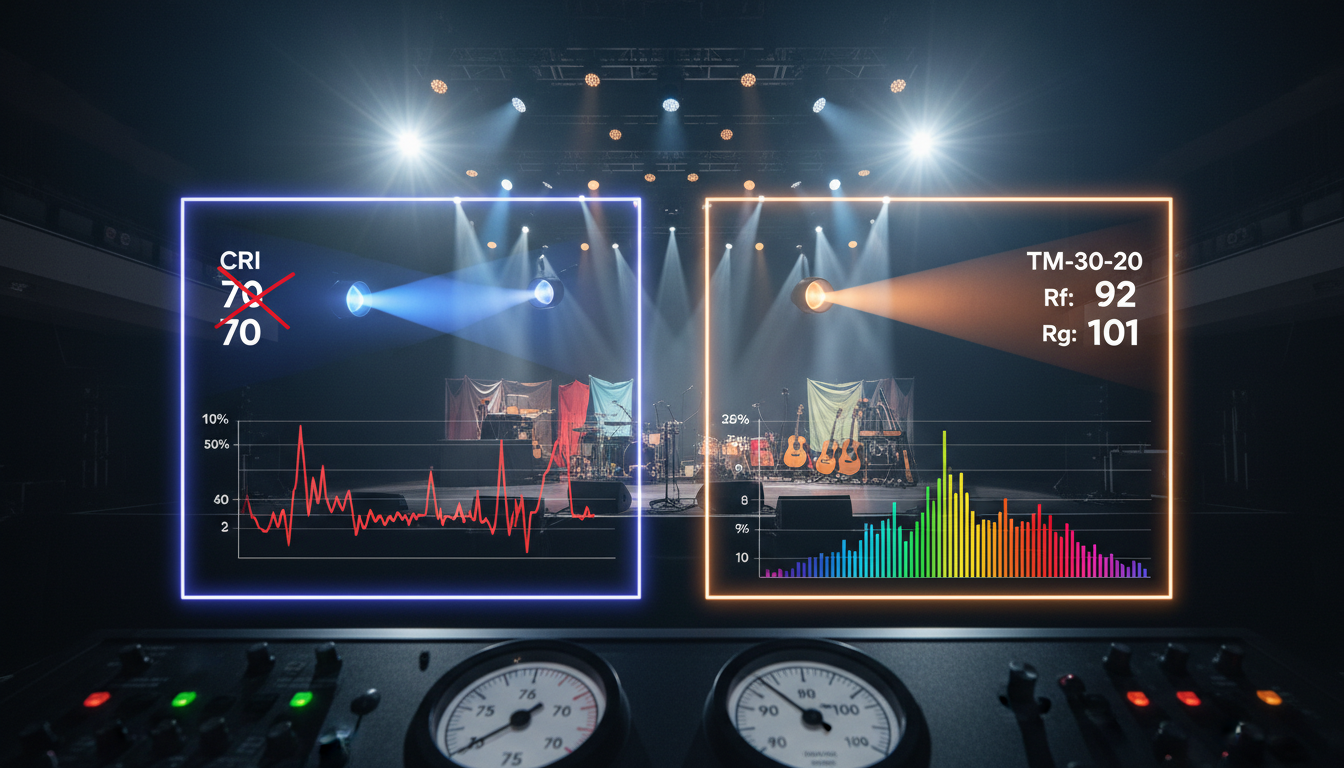
CRI (Color Rendering Index) measures how a light source reveals colors to the human eye compared to a reference source, while TLCI (Television Lighting Consistency Index) measures the same specifically for camera sensors. TM-30 is the modern successor, providing a dual-metric approach that analyzes both Color Fidelity (Rf) and Saturation (Rg) for a complete spectral picture.
Understanding the TM-30-20 vs CRI for stage comparison is vital for modern specification. While CRI provides a simple single-number average (Ra) based on just 8 pastel colors, TM-30 utilizes 99 color evaluation samples (CES) drawn from real-world objects like skin, foliage, and textiles. This makes TM-30 statistically harder to "game" and far more descriptive of how light will actually behave in a production environment.
The Metric Breakdown
- Target Audience:
- CRI: Human Audience (Live Theatre, Architectural).
- TLCI: Camera Sensors (Broadcast, IMAG, Film).
- TM-30: Lighting Designers requiring granular spectral data (Hybrid Events).
- Sample Size:
- CRI: 8 Pastel Samples (R1-R8).
- TLCI: 24 Macbeth ColorChecker Chart colors.
- TM-30: 99 Real-world reflectance samples.
The Legacy Standard: Why High CRI (Ra) Is Not Enough
CRI (Color Rendering Index) serves as a baseline average of color fidelity, but it is frequently misleading because it calculates the average shift of only eight unsaturated pastel samples (R1 through R8).
Because the standard CRI calculation allows manufacturers to average out poor performance in specific hues, a light can achieve a "High CRI" rating of 90+ while completely failing to render saturated reds or deep blues. This spectral gap is where the LED spectral power distribution R9 value becomes the critical differentiator for professionals.
The R9 Problem
The R9 value measures the rendering of saturated red. This metric is not included in the standard CRI Ra calculation, yet it is arguably the most important color for biological accuracy.
- Skin Tones: Human skin requires strong red reflection to look healthy. Low R9 values make actors look pale, sickly, or "wax-like."
- Set Design: Wood tones, brick, and warm costumes appear flat and brown without adequate deep red energy.
- False Positives: Many budget LED fixtures boast a CRI of 95 but hide an R9 value of less than 40. This is why you must always look at the extended photometric data.
As noted in detailed spectral analyses by industry experts, specifically regarding the importance of the red channel, a light source lacking in R9 will distort objects with significant red content, which includes nearly all human skin tones regardless of ethnicity (source: Waveform Lighting).
TLCI (Qa): Designing for the Lens and Live Stream
TLCI (Television Lighting Consistency Index) assesses color quality by simulating the specific spectral response of a standard 3-chip broadcast camera rather than the human eye.
In the age of hybrid events—where a theatrical production is simultaneously live-streamed—adhering to TLCI broadcast lighting standards is non-negotiable. The human eye has a logarithmic response to light and can auto-correct for white balance shifts. A camera sensor, however, has a linear response and is unforgiving of spectral spikes.
Why the Camera Sees Differently
LED emitters often have a "blue spike" (from the blue pump diode) and a "green valley" or surplus. While the eye might smooth this out, a camera sensor's Bayer filter will interpret these irregularities as color casts.
- The Green/Magenta Shift: A fixture might look white to the eye but cast a sickly green tint on camera. This is often due to a positive Duv (distance from the black body locus).
- Post-Production Costs: High TLCI values (>90) ensure that footage looks natural directly out of the camera. Low TLCI footage requires expensive and time-consuming color grading to fix skin tones.
- IMAG (Image Magnification): For large venues using IMAG screens, if your stage lights have low TLCI, the actors on the big screens will look different than they do on stage, creating a disconnect for the audience.
The European Broadcasting Union (EBU) developed this standard specifically to address these inconsistencies, providing a "Qa" score that predicts the amount of color correction needed (source: EBU).
The New Professional Standard: IES TM-30 Explained
IES TM-30 is the comprehensive color rendition standard that evaluates light sources using two distinct metrics: Color Fidelity (Rf) and Color Gamut (Rg), visualized on a vector graphic.
This system resolves the ambiguity of previous metrics by separating "naturalness" from "saturation." When analyzing color fidelity Rf vs gamut rg, you gain the ability to predict exactly how an LED engine will manipulate the visual spectrum.
The Two Axes of TM-30
- Fidelity Index (Rf):
- Scale: 0–100.
- Definition: How closely does the light match the reference source (similar to CRI, but more accurate)?
- Goal: An Rf of 100 means the light is indistinguishable from natural daylight or tungsten.
- Gamut Index (Rg):
- Scale: ~60–140.
- Definition: Does the light undersaturate (make colors gray) or oversaturate (make colors vivid)?
- Rg = 100: No saturation shift.
- Rg > 100: Colors appear more vivid/saturated (often preferred for rock and roll or effects).
- Rg < 100: Colors appear dull or desaturated.
The Vector Graphic
The true power of TM-30 lies in the Color Vector Graphic. This circular plot shows exactly which colors are being shifted. For example, a fixture might have a perfect Rf for blue but drastically oversaturate red. A lighting designer can look at the vector plot and instantly know, "This light will make my red costumes pop, but it might make skin tones look sunburned."
According to the Illuminating Engineering Society, this method allows for a more granular specification of light source color rendition, moving beyond the limitations of a single average number (source: Alcon Lighting / IES Overview).
Strategic Selection: Matching Fixtures to Production Needs
Selecting the right fixture involves balancing these metrics based on your primary use case. There is rarely one "perfect" light; there is only the best compromise for the specific application.
Scenario A: Pure Theatre (The "Human Eye" Standard)
- Priority: Fidelity and Red Rendering.
- Target Metrics: TM-30 Rf > 92, R9 > 80.
- Why: The audience is present. Immersion relies on costumes and sets looking natural. Saturation (Rg) should be near 100 to avoid cartoonish colors.
Scenario B: Broadcast & Studio (The "Sensor" Standard)
- Priority: Camera consistency and Flicker-free operation.
- Target Metrics: TLCI > 95, PWM > 3000Hz.
- Why: Editors need clean footage. A TLCI of 95+ implies that the footage will cut seamlessly with other high-quality sources without grading.
Scenario C: Rock & Roll / Concerts (The "Impact" Standard)
- Priority: Output (Lumens) and Saturation.
- Target Metrics: CRI > 80, TM-30 Rg > 100.
- Why: Subtlety is less important than punch. Often, a "Low Fidelity" light with High Saturation (Rg > 110) is actually preferred because it makes the band look larger than life and cuts through atmospherics/haze better.
The "Hybrid" Compromise
For multi-purpose venues (Houses of Worship, Corporate Events), aim for the "Goldilocks" zone:
- Rf: 90+
- TLCI: 90+
- Rg: 98-102
Expert Tips: Common Mistakes in Specifying White LEDs
Mistake 1: Ignoring LED BinningTwo fixtures from the same manufacturer labeled "95 CRI" can look visually different if they come from different "bins" (manufacturing batches).
- Tip: Always ensure your rental house or supplier provides fixtures from the same production batch, or request "tight binning" (within 2-3 MacAdam Ellipses) to ensure uniformity across the rig.
Mistake 2: Overlooking Red Shift (Tungsten Emulation)Traditional tungsten filaments shift to a warm amber glow as they dim. Generic white LEDs just get gray and dull.
- Tip: If you are replacing incandescent fixtures, look for "Dim-to-Warm" technology. Ensure the shift follows the Planckian Locus so it doesn't drift pink or green at low intensities.
Mistake 3: Prioritizing CCT Adjustability Over QualityVariable White (Bi-Color) fixtures often sacrifice spectral quality at the extreme ends of their CCT range (e.g., at 2700K or 6500K).
- Pro Tip: Always request the photometric report (IES files) specifically for the color temperature you use most often. Don't assume the specs listed for 4000K apply to 2700K.
Conclusion
The era of guessing color quality is over. To ensure your stage lighting is future-proof for 2026 and beyond, you must move beyond the limited scope of CRI and adopt a holistic view using TM-30 and TLCI. By prioritizing high-fidelity metrics like R9 and Rf, you protect your production from poor visuals on stage and on screen, ensuring that every costume, set piece, and actor looks exactly as intended.
Contact us today to optimize your stage lighting strategy with a custom photometric analysis.
FAQ
What is considered a good CRI for professional stage lighting?
For professional theatre and broadcast, a CRI (Ra) of 90 or higher is the standard benchmark. However, users should also verify the R9 (red) value is above 50-70 for accurate skin tone rendering.
Does high CRI always mean lower brightness (lumens)?
Generally, yes. Phosphors used to create high-fidelity white light absorb more energy, reducing total output. However, modern LED technology in 2026 has significantly narrowed this gap, offering high output with high CRI.
Why is TLCI important for live theatre if there are no cameras?
If the production is strictly for a live audience with no recording, IMAG, or archival filming, TLCI is less critical. However, most modern productions are recorded for promotional or archival purposes, making TLCI valuable regardless.
What is the difference between TM-30 Rf and Rg?
Rf (Fidelity) measures how closely colors match a natural reference source (similar to CRI). Rg (Gamut) measures the average saturation level—whether colors appear more vivid (Rg > 100) or duller (Rg < 100) than the reference.
Why do high CRI LEDs sometimes look green on camera?
CRI only measures color fidelity to the eye, not the camera sensor. A light can have high CRI but a spectral spike that aligns with a camera sensor's green channel. This is why checking TLCI or Green/Magenta shift (duv) is crucial.
Can I mix fixtures with different CRI ratings on the same stage?
It is risky. Mixing low CRI and high CRI fixtures can cause "metamerism," where costumes or skin tones change appearance as actors move between zones. It is best to keep key lighting consistent.
What is the R9 value and why does it matter?
R9 represents the rendering capability for strong red tones. Standard CRI (Ra) averages only pastel colors. Without a high R9, skin tones look pale or sickly, and red costumes appear brown or dull.
Is TM-30 better than CRI for LED lights?
Yes, TM-30 is a statistically superior metric. It uses 99 color samples (vs. CRI's 8-15) and provides data on saturation and hue shift, making it much harder for manufacturers to "game" or fake high quality.
A Stage of Limitless Possibilities: Moving Head lights Deliver Precise Control and Versatile Effects
LED Stage Strobe Light Comparison: Performance, Power, and Pricing Guide
Why Your Venue Needs LED Beam Lights: A Cost-Benefit Analysis
Spotlight vs. Stage Flood Lights: Which One Does Your Production Actually Need?
Spotlight vs. Floodlight vs. Beamlight: A Comparison of Moving Stage Lighting Fixtures
Mastering the Flash: 7 Advanced Strobe DJ Light Techniques for Pro Entertainers
Products
Do your lights support DMX512 and other control protocols?
Yes. All LiteLEES stage lights are fully compatible with DMX512. Many models also support RDM, Art-Net, and wireless DMX (optional), ensuring seamless integration with modern lighting control systems.
How long is the warranty period for your products?
We offer a standard 1-year warranty on all products, with extended warranty options available upon request. During the warranty period, we provide free technical support and parts replacement for non-human damage.
What is the lifespan of your LED stage lights?
Our LED lights use high-quality chips with a rated lifespan of over 50,000 hours. Proper usage and maintenance ensure long-term reliability and stable performance, making them a smart investment for any venue.
Can I customize the functions or software of the lights?
Absolutely. As a manufacturer with independent R&D capabilities, we offer customization for both hardware and software (such as DMX channel layout, built-in programs, or UI language). Contact us with your project needs, and our team will provide tailored solutions.
Company
What is LiteLEES’s main business?
LiteLEES specializes in the design, development, manufacturing, and sales of professional stage lighting, including moving head lights, beam lights, spot lights, wash lights, and LED par lights.
Stormy STRIKE M IP
LiteLEES LUMIX BEAM 420 IP
Want to get more up-to-date information?
If you have any comments or good suggestions, please leave us a message; later our professional staff will contact you as soon as possible.

We are professional stage lighting manufacturers offering OEM and ODM LED stage lights.
Contact
Email us
Call us
Address
No.6 Longnan Road, Huashan Town, Huadu District Guangzhou, Guangdong Province, China.
LiteLEES Professional
Less Lighting