
Flicker-Free Transitions: How to Master Dimming Curves for White LED Stage Wash Lights
- Quick Summary: Key Takeaways for Lighting Designers
- What is a Dimming Curve in LED Stage Lighting?
- Why Correct Curves Matter
- The Science of White Light: Linear vs. Square Law Curves
- Comparison of Curve Types
- Banishing the Flicker: PWM and Camera Refresh Rates
- Optimal Settings for Video
- Resolution Matters: 8-Bit vs. 16-Bit Dimming
- How to Implement 16-Bit Control
- Expert Tips: Troubleshooting Common Dimming Issues
- Troubleshooting Checklist
- Conclusion
- FAQ
- What is the best dimming curve for white LED stage lights?
- Why do my LED lights flicker on camera?
- What is the difference between 8-bit and 16-bit dimming?
- How do I stop my LED lights from popping on at low intensity?
- Does dimming affect the color temperature of white LEDs?
- Can I control LED dimming curves via DMX?
- What is tungsten emulation in LED wash lights?
- Why is my white wash light buzzing when dimmed?
Quick Summary: Key Takeaways for Lighting Designers
White LED wash lights require specific technical configurations to emulate the smooth, natural dimming of traditional incandescent fixtures. By adjusting three core settings—dimming curves, PWM frequency, and bit depth—designers can eliminate the "digital" look of modern fixtures.
- Square Law Curves are essential for white LEDs to match the human eye’s logarithmic sensitivity.
- PWM Frequency must be adjusted (often above 4,000Hz) to prevent camera flicker.
- 16-bit dimming resolution provides the necessary data steps to smooth out the bottom 5% of a fade.
- Red Shift Emulation helps maintain the warm aesthetic of tungsten during dimming.
What is a Dimming Curve in LED Stage Lighting?
A dimming curve is a software setting that dictates the relationship between the DMX control value sent from your console and the actual light output intensity of the fixture. This translation layer is critical because digital LEDs react instantly to voltage changes, unlike the slow thermal fade of filaments.
When you move a fader from 50% to 0%, the dimming curve determines the speed and slope of that drop in brightness. Without a selected curve, LEDs often drop linearly, which looks aggressive and unnatural to the audience. This is controlled via DMX512 dimming profiles inside the fixture's firmware, ensuring that the physical output matches the artistic intent of the lighting designer.
Why Correct Curves Matter
- Natural Transition: Prevents the light from "snapping" off at low levels.
- Console Synchronization: Ensures your lighting desk's fader position (e.g., 50%) matches the perceived brightness on stage.
- Broadcast Safety: Smooths out intensity changes that might otherwise look stepped or jerky on camera.
The Science of White Light: Linear vs. Square Law Curves
Square Law curves (often called Logarithmic curves) are the industry standard for dimming white LED wash lights because they modify the output to match human vision. While a linear curve increases brightness in a straight 1:1 ratio, a Square Law curve allocates more DMX steps to the lower end of the intensity range.
This distinction is vital because the human eye does not perceive brightness changes linearly. According to Wikipedia, human vision functions logarithmically, meaning we are far more sensitive to changes in dim light than in bright light. A linear fade looks smooth from 100% to 50%, but from 20% to 0%, it appears to drop off a cliff. The Square law vs linear curve debate is effectively settled for theatrical applications: Square Law is superior for natural-looking fades.
Comparison of Curve Types
- Linear Curve: Output matches DMX value exactly (50% DMX = 50% Output). Best for strobe effects or non-visual data control.
- Square Law (Logarithmic): Output follows a curve where 50% DMX might equal only 25% measured output. As noted by ETC, this compensates for the eye's sensitivity, making fades appear perfectly even.
- S-Curve: A hybrid curve that provides fine control at both the very bottom and very top of the range, softening the start and end of every transition.
Banishing the Flicker: PWM and Camera Refresh Rates
PWM frequency adjustment is the single most effective method for eliminating the strobing or banding lines seen on video cameras when shooting LED stages. Pulse Width Modulation (PWM) is the method LEDs use to dim; they turn on and off thousands of times per second to create the illusion of lower intensity.
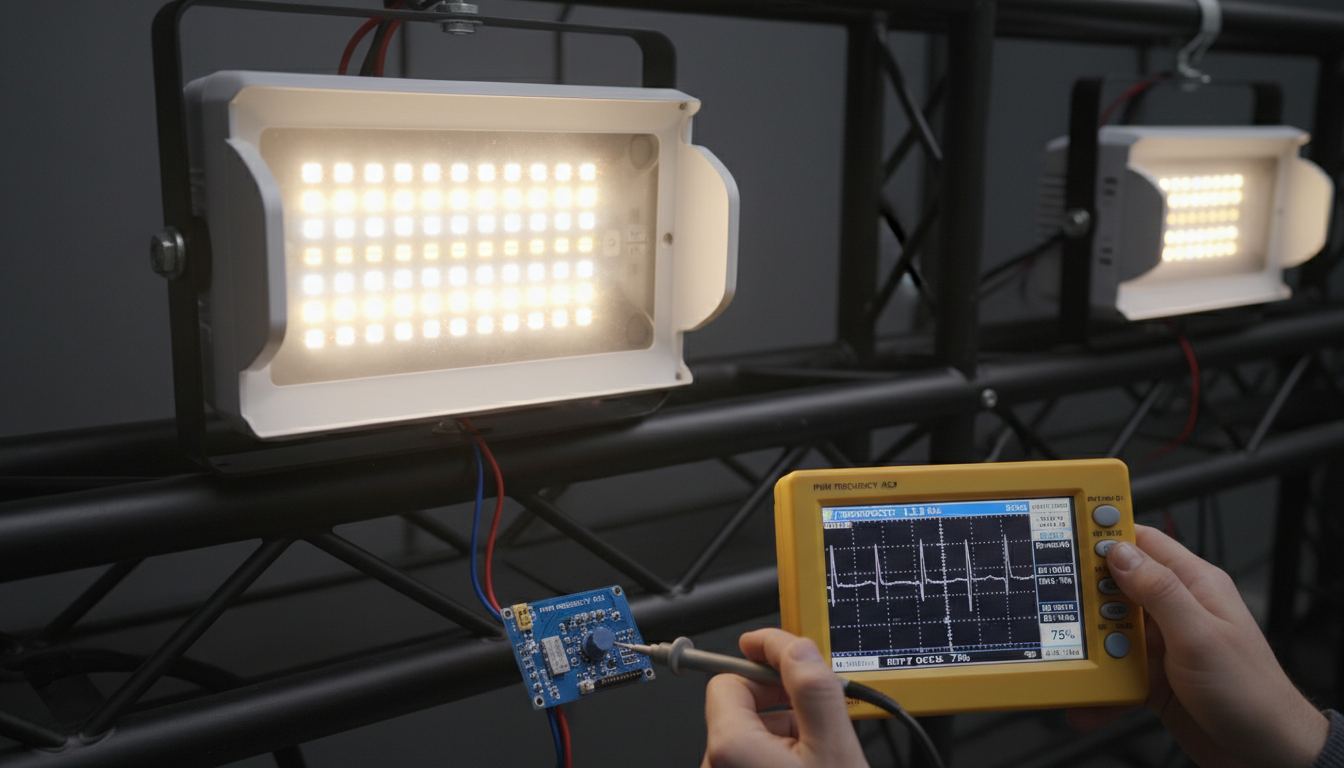
If this on/off cycle (frequency) is too slow, it clashes with the camera's shutter speed or frame rate. Standard LEDs might operate at 1,200Hz, which is often visible to high-definition cameras. To fix this, you must access the fixture's "Frequency" or "Refresh Rate" settings and increase the value.
Optimal Settings for Video
- Standard Video (30/60 fps): Set PWM to 4,000Hz or higher.
- Slow Motion/High Speed: Requires PWM settings of 25,000Hz or higher.
- Trade-off: Be aware that increasing PWM frequency can sometimes slightly reduce the maximum brightness or dimming smoothness of the fixture, so test the highest stable setting for your specific camera setup.
Resolution Matters: 8-Bit vs. 16-Bit Dimming
16-bit dimming resolution is the technical requirement for achieving truly seamless fades to black, specifically eliminating the visible "stepping" artifact. Stepping occurs when you can see the light jumping between brightness levels rather than flowing smoothly.
Standard DMX control is 8-bit, offering 256 steps of brightness (0-255). In a long fade (e.g., 10 seconds), 256 steps are not enough; the eye detects each small jump, especially at low intensities. 16-bit dimming combines two DMX channels (Coarse and Fine) to provide 65,536 steps of resolution. This massive increase in data density ensures that the "bottom 5%" of your fade—the most critical part for theater—is silky smooth.
How to Implement 16-Bit Control
- Fixture Mode: Set your LED wash light to a high-channel mode (often called "Tour Mode" or "16-bit Mode") via the onboard menu.
- Patching: Ensure your lighting console patch matches this mode. It will consume two DMX addresses per color/dimmer channel.
- Fine Channel: The console handles the math automatically, using the second channel to interpolate values between the coarse steps.
Expert Tips: Troubleshooting Common Dimming Issues
Even with the right curves and resolution, minor issues can plague a production. One advanced feature to look for in modern fixtures is Tungsten redshift emulation. This firmware feature automatically adds Amber or Warm White LED output as the intensity drops, mimicking the physics of a tungsten filament cooling down. This removes the cold, sterile look of an LED fading out.
Troubleshooting Checklist
- Fixing "Pop-On": If lights jump from 0% to 5% instantly, raise the "Dimmer Trim" or "Min Level" in the fixture's settings to bypass the unstable low-voltage threshold.
- Color Shift: If white light turns pink or green at low levels, verify that your dimming curve is applied globally to the master dimmer, not individually to RGBW channels.
- Audible Noise: If a fixture buzzes when dimmed, the PWM frequency adjustment might be set to an audible range (e.g., 1,000-3,000Hz). Shift it to 25kHz to move the noise into the ultrasonic (silent) range.
Conclusion
Mastering dimming curves is the difference between an amateur show and a professional production. By utilizing Square Law curves to match human vision, increasing PWM frequency for camera compatibility, and leveraging 16-bit resolution for smoothness, you can make digital LEDs feel as organic as traditional tungsten. These technical adjustments ensure that your white wash lights support the performance rather than distracting from it.
Contact us today to optimize your stage lighting strategy.
FAQ
What is the best dimming curve for white LED stage lights?
The 'Square Law' or 'Logarithmic' curve is generally best for white LEDs. It matches the human eye's non-linear perception of brightness, allowing for smoother fading in the critical 0-20% intensity range where linear curves often look abrupt.
Why do my LED lights flicker on camera?
Flicker is caused by the Pulse Width Modulation (PWM) frequency being out of sync with the camera shutter. Low-quality LEDs often have fixed, low PWM rates. To fix this, increase the fixture's PWM frequency setting to 4,000Hz or higher via the control menu.
What is the difference between 8-bit and 16-bit dimming?
8-bit offers only 256 steps of brightness, which can cause visible 'jumps' or stepping during slow fades. 16-bit offers 65,536 steps, creating essentially perfectly smooth transitions. 16-bit is highly recommended for theatrical wash lighting to avoid digital artifacts.
How do I stop my LED lights from popping on at low intensity?
First, check if the fixture supports 'Dimming Curves' and switch to Square or S-Curve. If available, use 16-bit mode. If the issue persists, adjust the 'Dimmer Threshold' or 'Cutoff' settings in the fixture's onboard menu to raise the starting point of the LED.
Does dimming affect the color temperature of white LEDs?
Yes, unlike Tungsten, LEDs maintain color temperature better, but cheap units may shift Green or Magenta at low levels. High-end fixtures often feature 'Tungsten Emulation' (Red Shift) to automatically warm the color temperature as the light dims, mimicking traditional bulbs.
Can I control LED dimming curves via DMX?
Yes, most professional fixtures allow you to select the curve via a specific DMX control channel or Control/Settings channel. Alternatively, curves can be set permanently via the fixture's rear LCD menu if you do not wish to use a DMX channel for it.
What is tungsten emulation in LED wash lights?
Tungsten emulation is a feature that simulates the 'amber drift' or 'red shift' of incandescent bulbs as they dim. It automatically adds warm white or amber LEDs as intensity drops, creating a more natural, vintage feel suitable for theater environments.
Why is my white wash light buzzing when dimmed?
Audible noise is often caused by power supply components vibrating at the PWM frequency. This is common in the 1kHz to 3kHz range. Switching to 'Silent Mode' or adjusting the PWM frequency to 25kHz (ultrasonic) can often reduce or eliminate this noise.
A Stage of Limitless Possibilities: Moving Head lights Deliver Precise Control and Versatile Effects
LED Stage Strobe Light Comparison: Performance, Power, and Pricing Guide
Why Your Venue Needs LED Beam Lights: A Cost-Benefit Analysis
Spotlight vs. Stage Flood Lights: Which One Does Your Production Actually Need?
Spotlight vs. Floodlight vs. Beamlight: A Comparison of Moving Stage Lighting Fixtures
Mastering the Flash: 7 Advanced Strobe DJ Light Techniques for Pro Entertainers
Products
Can I customize the functions or software of the lights?
Absolutely. As a manufacturer with independent R&D capabilities, we offer customization for both hardware and software (such as DMX channel layout, built-in programs, or UI language). Contact us with your project needs, and our team will provide tailored solutions.
Are your lights suitable for large-scale events and outdoor use?
Yes. Our professional stage lights—especially the Beam, BSW 3-in-1, and LED Par Series—are engineered with high-output brightness, wide beam angles, and robust housing. Some models come with IP-rated protection, making them suitable for outdoor applications like concerts, festivals, and sports events.
What is the lifespan of your LED stage lights?
Our LED lights use high-quality chips with a rated lifespan of over 50,000 hours. Proper usage and maintenance ensure long-term reliability and stable performance, making them a smart investment for any venue.
Company
Do you have your own factory?
Yes. We own a sheet metal factory and a complete in-house production line—from PCB to final assembly—ensuring strict quality control and fast delivery.
Can LiteLEES handle OEM/ODM orders?
Absolutely. With our strong R&D capabilities and advanced manufacturing, we can customize designs, features, and branding to meet your specific needs.
LP Profile 900
Stormy STRIKE M IP
LiteLEES LUMIX BEAM 420 IP
Want to get more up-to-date information?
If you have any comments or good suggestions, please leave us a message; later our professional staff will contact you as soon as possible.

We are professional stage lighting manufacturers offering OEM and ODM LED stage lights.
Contact
Email us
Call us
Address
No.6 Longnan Road, Huashan Town, Huadu District Guangzhou, Guangdong Province, China.
LiteLEES Professional
Less Lighting