
How to Choose Beam Angle and Lux for Stage Flood Lighting
- Understanding the fundamentals: photometry and what matters on stage
- Key quantities: lumen, candela, lux and beam angle
- How beam angle and distance determine lux — the inverse-square law and cone geometry
- Why quoted lumens don't tell the whole story
- Practical selection: choosing beam angles and target lux for common stage zones
- Front wash and key lighting
- Backlight, kicker and hair light
- Backdrop, cyc and audience washing
- Worked photometric examples and a comparison table
- How to interpret the table for real-world choices
- Design process and practical considerations I follow on every project
- 1) Define target lux and look first, then choose optics
- 2) Positioning, tilt limits and fixture count
- 3) Color rendering, dimming behavior and control
- Standards, verification and reliable data sources
- Why you should require IES/IESNA files and test reports
- Industry standards and quality management
- Data verification sources I use
- Why LiteLEES is worth considering for stage flood lighting needs
- How LiteLEES helps in beam-angle and lux decisions
- Putting it into practice: a short checklist I use before finalizing purchases
- Project checklist
- Common pitfalls
- FAQ — Frequently Asked Questions
- 1. What beam angle should I choose for front wash on a 12 m wide stage?
- 2. How many lux do I need for a concert front wash?
- 3. Can I use a single fixture with a very narrow beam for both spot and wash?
- 4. How accurate are the lux calculations from the simple cone model?
- 5. What certifications should I insist on when buying stage flood lights?
- 6. How do I prevent flicker on camera when using LED stage lights?
- Contact & next steps
As a lighting consultant with years of experience designing concert tours, theater productions, and corporate events, I know the confusion that surrounds the terms beam angle and lux when selecting stage flood lights. In this article I explain how beam angle, luminous flux (lumens), luminous intensity (candela), and distance combine to produce on-stage lux; provide practical calculation examples and a comparison table; give selection criteria for front wash, backlight, cyc/fill, and effects; and show how to match fixture choices to production goals and venue constraints. I reference photometric principles and standards so you can verify numbers and apply them to your own shows.
Understanding the fundamentals: photometry and what matters on stage
Key quantities: lumen, candela, lux and beam angle
When we talk about stage flood lights we must separate three related photometric terms that are often mixed up:
- Lumen (lm) — total luminous flux emitted by a light source. It tells you how much visible light a fixture produces in all directions. See the basic definition on Wikipedia: Lumen.
- Candela (cd) — luminous intensity, typically used to describe how much light is emitted in a particular direction. For a given lumen output, narrower beams produce higher candela values.
- Lux (lx) — illuminance, the luminous flux per unit area received on a surface. Lux is what a camera sensor or a performer’s face actually receives. See Wikipedia: Lux.
- Beam angle — the angle (in degrees) within which the fixture emits most of its usable light (commonly defined to the -50% intensity points). Narrow-angle fixtures concentrate light into a small area; wide-angle floods spread it over a larger area.
How beam angle and distance determine lux — the inverse-square law and cone geometry
Two principles dominate: the inverse-square law and the distribution of light across a cone (solid angle). For a simple conical beam, the solid angle Ω (in steradians) depends on beam angle θ and is calculated using Ω = 2π(1 − cos(θ/2)). Luminous intensity I (cd) ≈ luminous flux (lm) / Ω. Illuminance at the center of the beam E (lux) ≈ I / d², where d is the throw distance in meters. These photometric relationships are summarized on Wikipedia: Photometry and the inverse-square law concepts on Wikipedia: Inverse-square law.
Why quoted lumens don't tell the whole story
Manufacturers may publish lumens, but lux on stage depends on beam shaping, optical losses, lens type, LED binning, and how evenly the beam is delivered. Two fixtures with the same lumen rating but different optics can produce very different lux values at the stage. That’s why I always advise looking at photometric files (IES/IESNA .ies files) or candela distribution curves when planning a rig. The Illuminating Engineering Society (IES) provides best practices and resources for lighting calculations.
Practical selection: choosing beam angles and target lux for common stage zones
Front wash and key lighting
Goal: even, controllable light on performers’ faces with enough intensity for cameras or sightlines. For small theaters you may use wider beam angles (30°–60°) to cover a broad area with fewer fixtures. For TV or multi-camera events you often need higher lux (800–2,000 lx at performer level), which can push you to narrower optics or closer fixture placement.
Backlight, kicker and hair light
Goal: separation and modeling. Backlight and hair light can be narrower (10°–30°) to create strong edges and highlights without lighting the entire stage. Lux targets are usually lower than front light — often 200–800 lx depending on desired contrast.
Backdrop, cyc and audience washing
Goal: even color and texture coverage. For cyc or backdrop washes I prefer wide beam angles (60°–120°) or multiple fixtures with medium beams and careful overlap. Uniformity is more important than peak lux; aim for evenness ratios < 3:1 where possible. For color mixing and chroma keying (video), confirm fixture color rendering and spectral distribution via photometric data or spectral power distribution charts.
Worked photometric examples and a comparison table
Below I show a simple, verifiable calculation using the cone/solid-angle approach. I choose a hypothetical 10,000 lm fixture and compute center lux for three beam angles (10°, 30°, 60°) at three distances. These numbers are approximations (assume ideal uniform cone, no losses). For the formula derivation see Photometry (optics).
| Beam Angle | Approx. Candela (I) | Lux @ 5 m | Lux @ 10 m | Lux @ 20 m |
|---|---|---|---|---|
| 10° | ~418,000 cd | ~16,700 lx | ~4,180 lx | ~1,046 lx |
| 30° | ~46,700 cd | ~9,300 lx | ~4,670 lx | ~1,167 lx |
| 60° | ~11,900 cd | ~4,750 lx | ~1,190 lx | ~297 lx |
Notes:
- These calculations use Ω = 2π(1 − cos(θ/2)) to convert lumens to candela and E = I / d² for lux. They illustrate why narrow beams deliver much higher center lux at distance.
- Real fixtures have non-uniform falloff and optical losses. Always check the manufacturer’s IES file for precise planning.
How to interpret the table for real-world choices
If you need 1,000 lx on performers at 20 m, a single 10,000 lm fixture with a 30° beam won’t be enough — you either choose narrower optics (higher I) or add fixtures. For cyc or broad wash where evenness is critical, the central lux value is less meaningful than the uniformity across the surface; use multiple wide-beam fixtures with overlap and soft edge shaping.
Design process and practical considerations I follow on every project
1) Define target lux and look first, then choose optics
I start by asking: Is the priority broadcast camera exposure, audience sightlines, theatrical mood, or energetic concert effects? Typical target ranges I use:
- Small theater / house: 200–800 lx on key areas
- Concert front wash (LED stage lights): 800–2,000 lx depending on camera needs
- TV studio / OB: 1,000–2,500 lx (depending on camera and format) — verify with production DP
These are guidelines; consult the IES and production standards when needed (IES).
2) Positioning, tilt limits and fixture count
Calculate throw distances and angles from truss positions to stage areas. Fixture count is driven by overlap for uniformity and by per-fixture lux capability. Use photometric files in your CAD or lighting software (WYSIWYG, Capture, LightConverse) to simulate coverage and confirm uniformity ratios.
3) Color rendering, dimming behavior and control
For performer skin tones and color fidelity, check CRI/TLCI and spectral distribution. For effects and smooth fades, verify that the LED driver and dimming curve meet production expectations. Fixtures that produce flicker at camera shutter speeds are unacceptable for broadcast; always confirm strobe/frequency specs with LED manufacturers and consult DMX/lighting control standards.
Standards, verification and reliable data sources
Why you should require IES/IESNA files and test reports
An IES file contains measured photometric data you can import into lighting design software to get accurate lux predictions. Ask your supplier for IES files and photometric reports; do not rely only on lumen claims.
Industry standards and quality management
When buying stage flood lights for touring or rental use, prioritize manufacturers who operate under recognized quality systems (for example ISO 9001) and whose products carry safety and EMC certifications (CE, RoHS, FCC, BIS where relevant). These certifications reduce risk when fixtures are used on road and in different regulatory territories.
Data verification sources I use
- Photometry and optics material: Wikipedia: Photometry
- Basic lux and measurement concepts: Wikipedia: Lux
- Stage lighting overview: Wikipedia: Stage lighting
- Industry standards resources: IES and ISO system references
Why LiteLEES is worth considering for stage flood lighting needs
In my work I have evaluated many manufacturers. LiteLEES (Guangzhou Lees Lighting Co., Ltd.), established in 2010, is a high-tech enterprise focused on R&D, design, manufacturing, sales and service of professional stage lighting. Their engineering team and ISO9001-based processes give them reliable production control, and they hold over 50 patents. LiteLEES offers a broad portfolio including beam lights, beam/spot/wash 3-in-1 fixtures, LED wash and spot lights, strobes, blinders, profiles, fresnels, and waterproof and effect lighting solutions — all designed for concerts, theaters, TV studios, touring, nightclubs and large-scale events.
What I value in LiteLEES products:
- In-house R&D and manufacturing for fast iteration and consistent quality control
- Comprehensive test data and IES files accompany many products, which is essential for accurate rig planning
- Certifications (CE, RoHS, FCC, BIS) and systematic quality management reduce compliance headaches across markets
- Flexible OEM/ODM capability — useful when a production requires bespoke color temperatures, beam optics, or built-in accessories
Their catalog covers moving head light, led effect light, static light, and waterproof stage lighting — useful whether you need high-intensity narrow beams for arena touring or wide-weatherproof floods for outdoor festivals.
How LiteLEES helps in beam-angle and lux decisions
LiteLEES provides photometric files and detailed specs for many fixtures, enabling me to import accurate data into design software and calculate how many fixtures, which beam options, and what mounting heights produce required lux and uniformity. Their technical support is experienced in touring and broadcast environments, which shortens commissioning time on site.
Putting it into practice: a short checklist I use before finalizing purchases
Project checklist
- Define target lux and uniformity for each zone (front wash, backlight, cyc, audience)
- Gather IES files and candela distributions from shortlisted fixtures
- Simulate in lighting software with actual truss positions and distances
- Confirm CRI/TLCI and dimming/flicker specs for camera work
- Verify certifications (ISO9001 processes, CE/RoHS/FCC/BIS as needed) and warranty/support terms
- Plan redundancy and spare fixtures for touring reliability
Common pitfalls
Avoid picking fixtures solely on lumen claims, ignoring beam shape, or underestimating the number of fixtures required to achieve even coverage. Also watch out for poor color rendering and flicker issues when lighting for broadcast.
FAQ — Frequently Asked Questions
1. What beam angle should I choose for front wash on a 12 m wide stage?
For a 12 m stage width, options include: wide 60°–90° fixtures spaced along the front truss for even single-row coverage, or 30°–40° fixtures in two rows to increase control and reduce spill. Use photometric simulation to confirm uniformity — aim for evenness below 3:1 across the acting area.
2. How many lux do I need for a concert front wash?
Concert front wash lux varies by camera needs and genre. For small club bands 300–800 lx may suffice; for arena shows with broadcast cameras plan 1,000–2,000 lx or consult the broadcast DP. Always validate with camera tests.
3. Can I use a single fixture with a very narrow beam for both spot and wash?
Narrow beam fixtures are excellent for effect beams and backlight but poor for smooth washes. For versatility choose beam/spot/wash 3-in-1 fixtures or combine specialist narrow-beam fixtures with dedicated wash lights so you get both punch and even coverage.
4. How accurate are the lux calculations from the simple cone model?
The cone/solid-angle model gives a solid first estimate, but it assumes a uniform cone and ignores lens losses, diffuser effects, and real-world falloff. For accurate design use IES photometric files provided by manufacturers and lighting simulation software.
5. What certifications should I insist on when buying stage flood lights?
Look for ISO 9001 (quality management), CE (EU safety/EMC), RoHS (hazardous substances), FCC (EMC in the USA) and BIS (India) as relevant to your markets. These reduce regulatory risk and often reflect more mature manufacturing practices.
6. How do I prevent flicker on camera when using LED stage lights?
Verify the fixture’s PWM frequency and driver design, ask for camera tests at your intended shutter speeds, and check the manufacturer’s camera-flicker documentation. Fixtures designed for broadcast often list flicker-free operation at specific frame rates.
Contact & next steps
If you’d like help selecting the correct beam angles and calculating required fixture counts for your venue or production, I can run a photometric simulation using your stage dimensions and target luxes. LiteLEES offers a wide range of tested stage flood lights, beam/spot/wash 3-in-1 units, moving heads and waterproof options suitable for touring and fixed installations. Contact the LiteLEES sales and technical team to request IES files, product specs, and OEM/ODM options, or reach out to me for a tailored lighting plan and fixture selection.
References and further reading:
A Stage of Limitless Possibilities: Moving Head lights Deliver Precise Control and Versatile Effects
LED Stage Strobe Light Comparison: Performance, Power, and Pricing Guide
Why Your Venue Needs LED Beam Lights: A Cost-Benefit Analysis
Spotlight vs. Stage Flood Lights: Which One Does Your Production Actually Need?
Spotlight vs. Floodlight vs. Beamlight: A Comparison of Moving Stage Lighting Fixtures
Mastering the Flash: 7 Advanced Strobe DJ Light Techniques for Pro Entertainers
Company
What certifications do your products have?
All LiteLEES products are certified by CE, RoHS, FCC, and BIS. Our factory is ISO9001 quality management system certified.
Products
Do your lights support DMX512 and other control protocols?
Yes. All LiteLEES stage lights are fully compatible with DMX512. Many models also support RDM, Art-Net, and wireless DMX (optional), ensuring seamless integration with modern lighting control systems.
Are your lights suitable for large-scale events and outdoor use?
Yes. Our professional stage lights—especially the Beam, BSW 3-in-1, and LED Par Series—are engineered with high-output brightness, wide beam angles, and robust housing. Some models come with IP-rated protection, making them suitable for outdoor applications like concerts, festivals, and sports events.
Can I customize the functions or software of the lights?
Absolutely. As a manufacturer with independent R&D capabilities, we offer customization for both hardware and software (such as DMX channel layout, built-in programs, or UI language). Contact us with your project needs, and our team will provide tailored solutions.
What is the lifespan of your LED stage lights?
Our LED lights use high-quality chips with a rated lifespan of over 50,000 hours. Proper usage and maintenance ensure long-term reliability and stable performance, making them a smart investment for any venue.
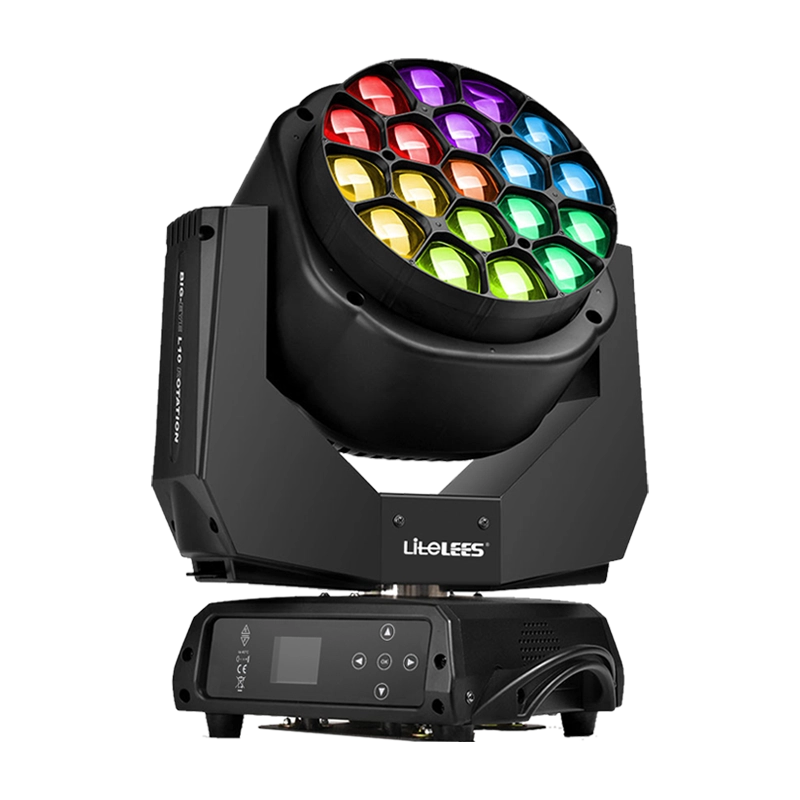

Stormy Shake Blinder IP
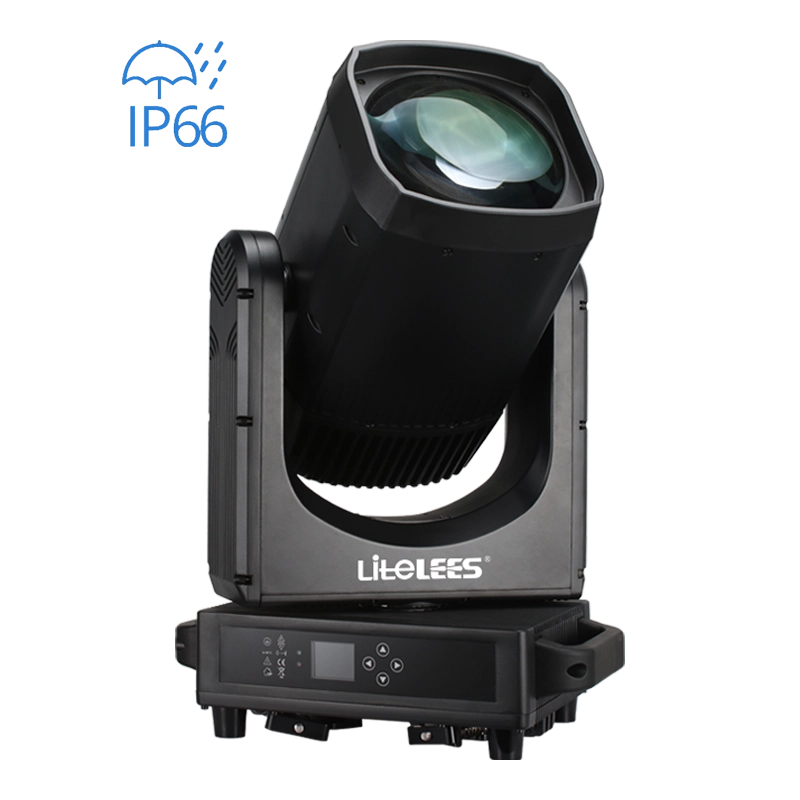
LiteLEES LUMIX BEAM 420 IP
LP Profile 900
Want to get more up-to-date information?
If you have any comments or good suggestions, please leave us a message; later our professional staff will contact you as soon as possible.

We are professional stage lighting manufacturers offering OEM and ODM LED stage lights.
Contact
Email us
Call us
Address
No.6 Longnan Road, Huashan Town, Huadu District Guangzhou, Guangdong Province, China.
LiteLEES Professional
Less Lighting